We collaborate (but don’t take ownership) of projects related to the use of our Network Analytics Software. Through collaboration, we help our patrons solve complex problems and create customized plugins to facilitate computational solutions.
Our open source research tools are available to the public through GitHub at: http://www.github.com/nxtlight/
The following examples are our own projects, created to demonstrate the wide variety of problems that can benefit by our technology.
Project 1 – The Classic Airplane Boarding Problem
The airline boarding problem is one of the most well-studied yet persistently unsolved challenges in operations research. Faster methods are known, yet airlines systematically choose slower ones for economic and behavioral reasons. This project applies the NxtLight Framework to model the boarding process as a co-evolving network in which passenger positions (nodes), aisle interactions (edges), and social-psychological states (signal content) all evolve simultaneously. Five canonical boarding strategies are simulated, the full 17-module NxtLight analytical suite is applied, and three novel solutions derived from the multi-method analysis are proposed. A deep-dive on boarding psychology — fairness perception, loss aversion, status dynamics, and control — explains why optimal solutions are systematically rejected and what this implies for realistic improvement.
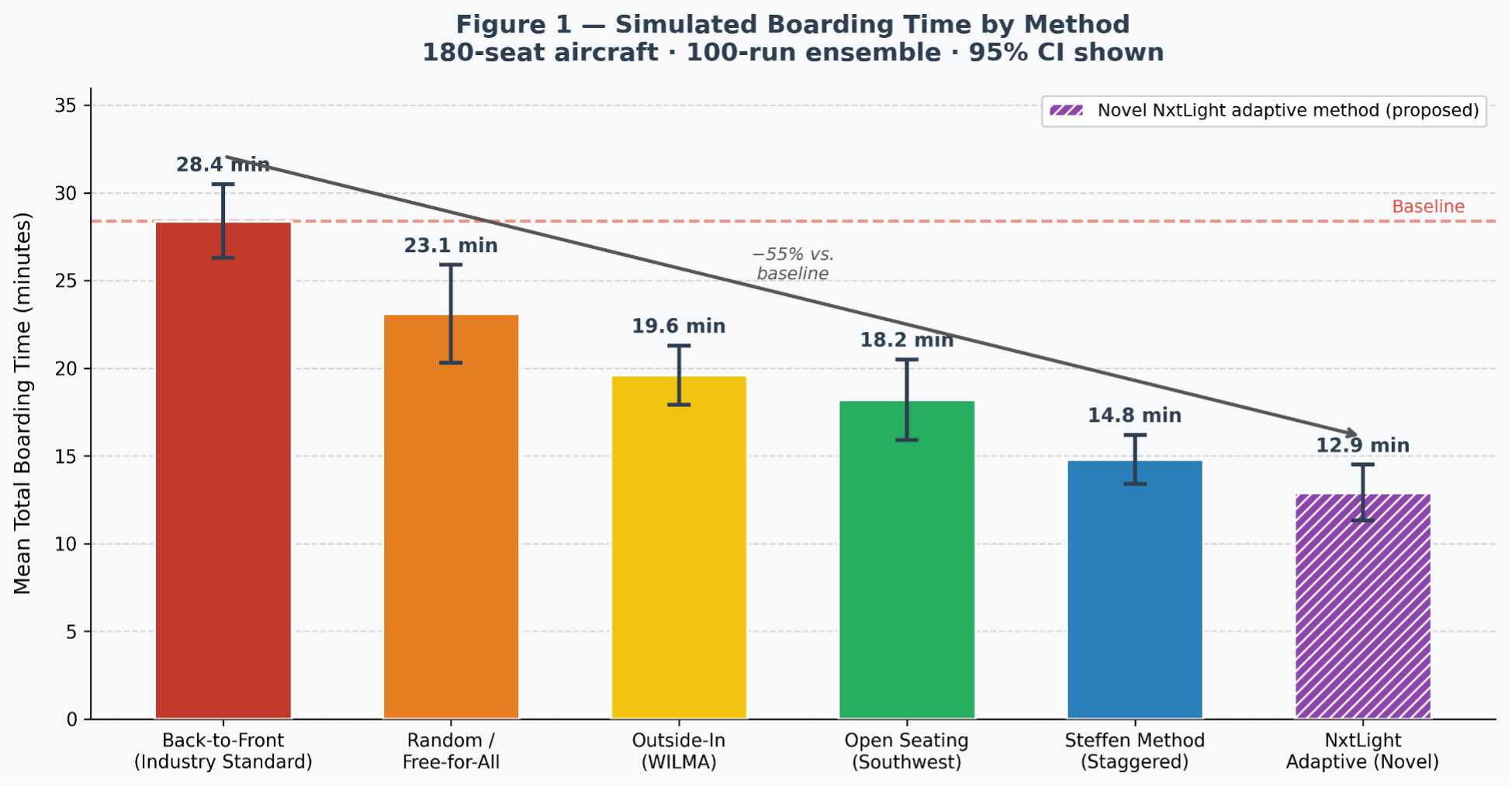
The complete study report is found here
Project 2 – Star Formation
The formation of a star is the result of a carefully orchestrated competition among five major vector forces, each dominant in a different spatial regime and at a different evolutionary stage. Gravity is the universal driver, but it cannot act alone: without centrifugal support to form a disk, without gas drag to allow solids to drift and grow, without thermal pressure to set initial conditions and eventually halt collapse, and without magnetic fields to transport the angular momentum that would otherwise prevent collapse entirely, the molecular cloud gas would remain inert or fragment in ways inconsistent with observed stellar populations.
The magnetic force is arguably the least intuitive yet most consequential of the five. Through the interplay of ambipolar diffusion, Ohmic dissipation, the Hall effect, and the magnetocentrifugal jet mechanism, magnetic fields regulate the rate, efficiency, and angular momentum budget of star formation across all scales from ~100 AU cloud cores down to the sub-AU jet-launching regions. Future observations with ALMA, JWST, and the next-generation VLA will continue to constrain these mechanisms through resolved disk kinematics, jet proper motions, and magnetic field polarimetry.
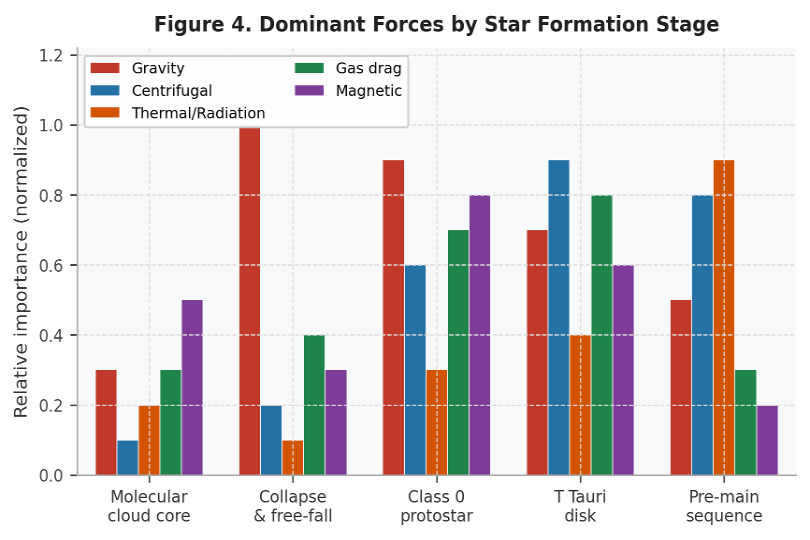
Relative importance of each force during the five main stages of star formation, from the initial molecular cloud core through the pre-main-sequence phase. Magnetic forces peak during the Class 0 protostar stage, when field-envelope coupling is strongest; thermal/radiation pressure rises steadily as the star contracts and luminosity increases
Please contact me here: william25@nxtlight.com
