Computational Framework
Our major contribution is the NxtLight Computational Research Tool, free for academic use in exploring the behavior of a variety of Complex Systems. (See applications page.)
The NxtLight Framework addresses a gap in scientific software: the absence of a unified, domain-agnostic platform for simulating dynamical processes on networks whose topology, node state, and edge connectivity can evolve in real time. Existing tools either target a specific domain (epidemiological compartment models, power grid simulators, financial contagion packages) or require deep software engineering expertise to adapt.
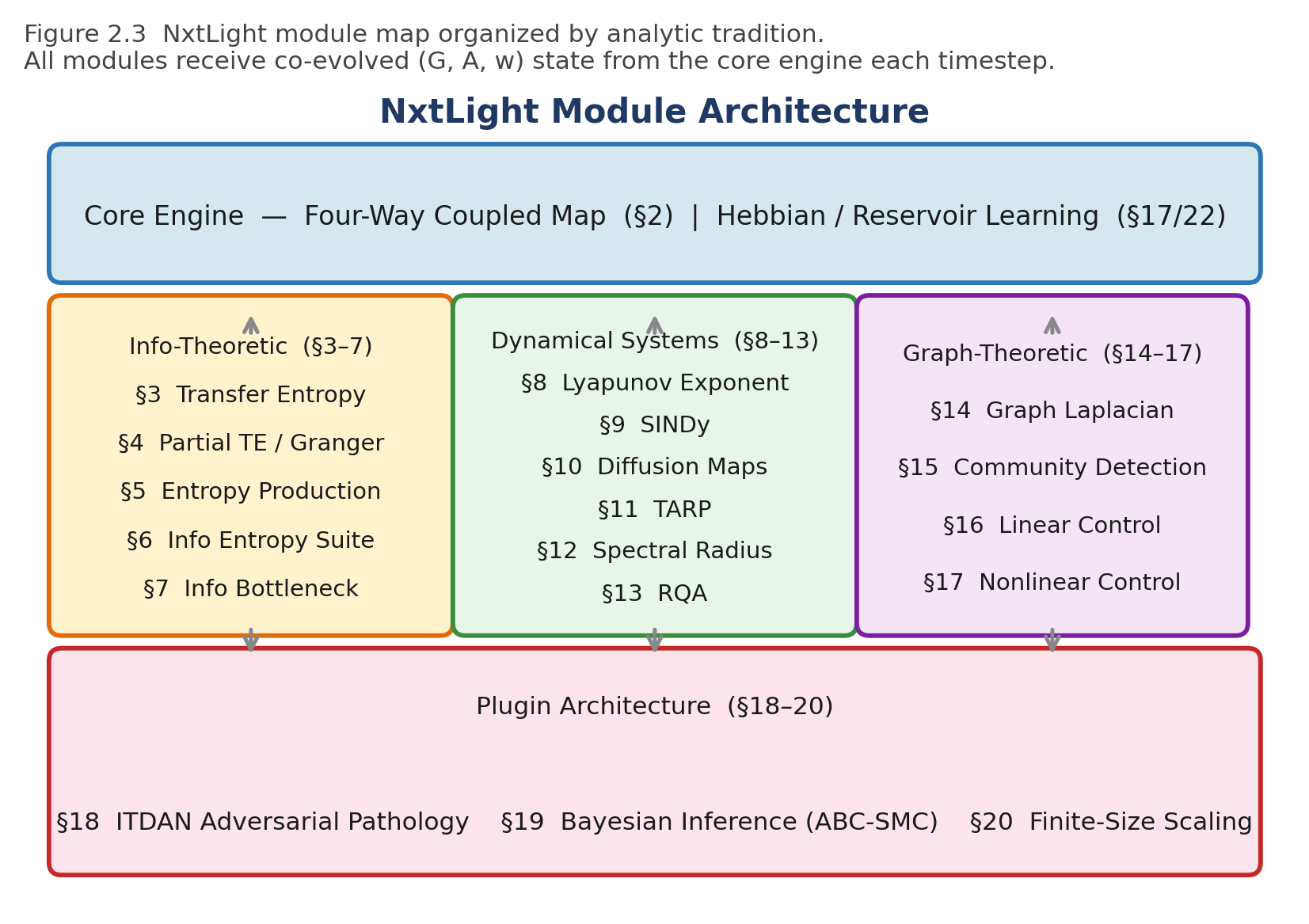
The NxtLight Framework provides a configurable middle layer: domain experts define their system in a configuration file; the framework handles graph management, time integration, analytical module dispatch, visualization, and output. use Python for modeling and generating graphs for analyses. This page provides an introduction to that process and some example algorithms. Please consider all information tentative and for instructional purposes only. All final presentations are in PDF form and available by request.
The Computing Package Exists in the Following Submodules
| Submodule | Responsibility | Key Dependencies |
| engine/ | Graph state management, time stepping, rewiring logic, event dispatch | NetworkX, SciPy, CuPy (optional) |
| config/ | TOML parsing, schema validation, default injection, error reporting | tomllib, pydantic |
| modules/ | Built-in analytical plugins: TE, SINDy, diffusion maps, homology, Lyapunov, TARP, hub ID | NumPy, SciPy, pysindy, ripser, nolds |
| gui/ | Tabbed window, graph canvas, chart panels, status bar, color mapping | matplotlib, Plotly/Dash, PyQt6 |
| outputs/ | Spreadsheet writer, chart export, run metadata logging | openpyxl, pandas |
| plugins/ | Drop-in directory scanned at startup; also entry-point discovery | importlib.metadata |
| utils/ | GPU detection, logging, progress tracking, unit conversion | CuPy, psutil, loguru |
The following modules are built into the framework as reference implementations. Each is also a fully compliant plugin and can be replaced or extended by a community module of the same name. All modules are documented with NumPy-style docstrings and tested in the pytest suite.
| Module | Method | Primary Open-Source Dependency |
| transfer_entropy | Kraskov k-NN estimator (default), Gaussian estimator, binned estimator. Measures directed information flow between node time series. | IDTxl, pyinform |
| sindy | Sparse Identification of Nonlinear Dynamics. Recovers governing equations from node state time series using the STLSQ optimizer. | pysindy |
| diffusion_maps | Spectral embedding of the graph state manifold. Identifies slow collective variables and intrinsic low-dimensional structure. | PyDiffMap |
| persistent_homology | Topological persistence of graph connectivity at multiple spatial/weight scales. Produces persistence diagrams and Betti number time series. | ripser, persim |
| lyapunov | Lyapunov exponent estimation from node state divergence trajectories. Characterizes attractor stability and chaos onset. | nolds |
| tarp | Tests of Accuracy with Random Points. Validates simulation outputs against observational or synthetic reference data. | tarp (custom implementation) |
| hub_identification | Betweenness centrality, degree entropy, eigenvector centrality, and TE-based hub scoring. Updated at each analysis window. | NetworkX, NumPy |
Simulations include interactive GUI panels with dynamical processes and adjustable parameters.